
Four concurrent radios
Multiple MIMO transceivers provide greater capacity, network diversity and resilience.


Rajant Kinetic Mesh
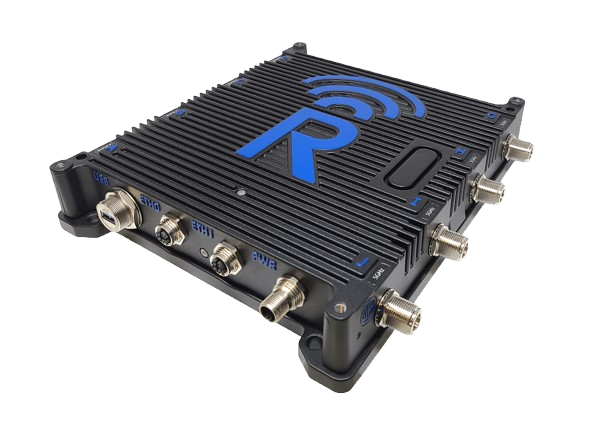
The high-capacity mesh backbone.
The Rajant Peregrine BreadCrumb® is a rugged, high-performance wireless mesh node designed for demanding mobile and industrial environments. Four concurrent MIMO transceivers and Rajant InstaMesh® deliver high-capacity, resilient connectivity that adapts as equipment and network conditions change.
*Up to 2.3 Gbps for FE1-2255B; up to 3.5 Gbps for FE1-2255X. Physical-layer data rates.
The Rajant Peregrine provides a powerful wireless mesh backbone for mining, ports, heavy equipment, industrial automation and other operations where moving assets need dependable data, voice and video connectivity.
Its four 2×2 MIMO transceivers operate concurrently to provide multiple network paths, improved resilience and high aggregate data rates. Rajant InstaMesh® automatically selects efficient routes as machines move, links become congested or network conditions change — without relying on a central controller.
The Peregrine can also integrate with existing Ethernet and Wi-Fi equipment and is interoperable with other Rajant BreadCrumb® nodes. Its IP67 enclosure and wide operating temperature range make it suited to harsh industrial sites.
Compare the FE1-2255B and FE1-2255X configurations. Figures are taken from the Rajant Peregrine manufacturer specification sheet.
| Specification | FE1-2255B | FE1-2255X |
|---|---|---|
| Wireless configuration | Two 2.4 GHz + two 5 GHz 2×2 MIMO radios | Two 2.4 GHz + two 5 GHz 2×2 MIMO radios |
| Combined maximum physical-layer data rate | Up to 2.3 Gbps | Up to 3.5 Gbps |
| 2.4 GHz maximum per-radio data rate | 300 Mbps | 573.5 Mbps |
| 5 GHz maximum per-radio data rate | 866.7 Mbps | 1,201 Mbps |
| Maximum RF transmit power | 30 dBm* | 30 dBm* |
| Power consumption | 10 W average idle; 34 W peak at 48 V | 15 W average idle; 65 W peak at 56 V |
| Power over Ethernet | IEEE 802.3bt Type 3 / PoE++ or 38–60 VDC passive PoE | IEEE 802.3bt Type 4 / PoE++ or 38–60 VDC passive PoE |
| Weight | 2,946 g | 3,136 g |
| Specification | FE1-2255B | FE1-2255X |
|---|---|---|
| 2.4 GHz frequency | 2402–2482 MHz | 2402–2482 MHz |
| 5 GHz frequency | 5150–5850 MHz (regional channels) | 4.9 GHz and 5150–5850 MHz (regional channels) |
| 2.4 GHz modulation | DSSS, CCK, OFDM up to 64-QAM | DSSS, CCK, OFDM up to 1024-QAM |
| 5 GHz modulation | OFDM up to 256-QAM | OFDM up to 1024-QAM |
| Antenna connectors | Type N female | Type N female |
| Specification | Peregrine BreadCrumb® |
|---|---|
| DC power | 20–60 VDC |
| Ethernet | 2 × M12 X-Code female, 10/100/1000 Mbps, auto MDI/MDIX |
| USB | USB 2.0 Type A female host port for firmware upgrades, USB-based zeroize and GPS add-on |
| Status LEDs | 2 |
| DC power connector | M12 L-Code male |
| Dimensions | 264.9 × 253.7 × 46.2 mm |
| Operating temperature | −40°C to +70°C |
| Storage temperature | −40°C to +80°C |
| Enclosure | Designed for IP67 dust and water protection |
| Warranty | 1 year |
| MTBF | 139,907 hours (manufacturer-stated test conditions) |
*RF power, available channels and frequency bands depend on local regulations and product configuration. Maximum data rates are physical-layer figures, not guaranteed real-world throughput. Consult the specification sheet for full security, sensitivity and certification details.
Multiple MIMO transceivers provide greater capacity, network diversity and resilience.
The FE1-2255X supports up to 3.5 Gbps combined physical-layer data rate.
Automatically selects efficient network paths without a central controller.
Maintains network links as vehicles, machinery and other assets move.
A rugged, environmentally sealed enclosure for challenging industrial conditions.
Configurable encryption and per-hop, per-packet authentication options.
Supports access-point and client connectivity for compatible Wi-Fi devices.
Works alongside other Rajant BreadCrumb nodes as networks grow.
Reliable high-capacity mesh connectivity for moving equipment and demanding industrial operations.

Connect mobile plant, autonomous vehicles and remote operations across changing sites.

Support vehicle movements, container handling and high-bandwidth communications across terminals.

Keep industrial machinery, automated processes and connected equipment communicating.